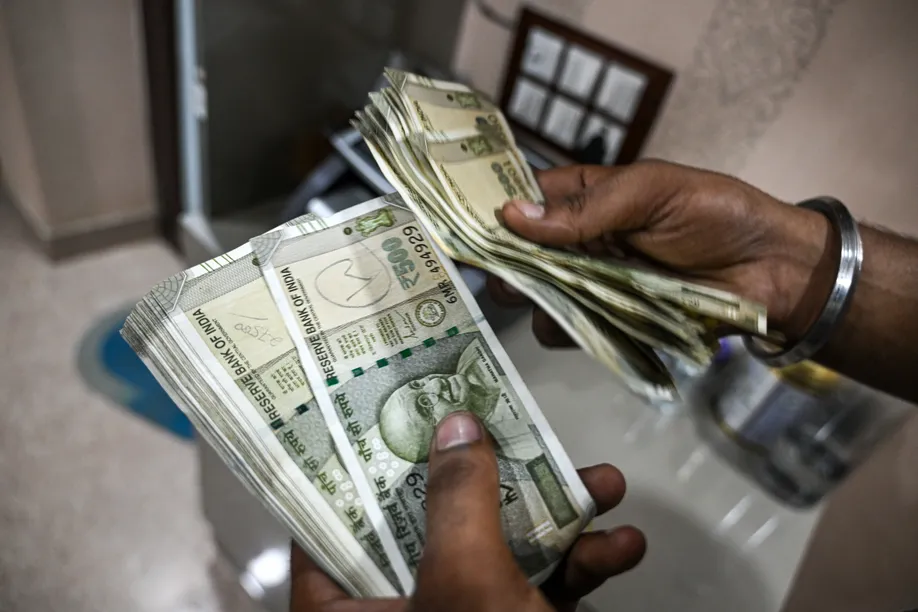
The Indian rupee has slumped to a new all-time low, reflecting mounting pressure from international policy changes and persistent concerns about global trade. The recent decision by the United States government to sharply increase visa fees, coupled with ongoing tariff disputes, has intensified downward pressure on Asia’s worst-performing currency this year.
Record Weakness Against the Dollar
On Tuesday, the rupee weakened as much as 0.5%, reaching 88.79 per dollar. This surpassed the previous record low of 88.4563 set earlier in September, signaling the growing strain on India’s economy. The depreciation marks a cumulative decline of around 3.5% in 2025, placing the rupee at the bottom of Asian currency performance rankings.
While a weaker rupee can sometimes benefit exporters by making Indian goods more competitive in international markets, the pace and cause of the fall have raised concerns. The sudden surge in US visa fees and broader geopolitical tensions are creating uncertainty for businesses and investors alike.
Impact of the US Visa Fee Hike
A key factor behind the rupee’s latest slide was the announcement of a one-off \$100,000 fee for H-1B visa applications. These visas are critical for Indian technology firms, which rely heavily on deploying skilled workers to the United States. The sharp rise in fees threatens to erode profit margins for Indian IT companies, a sector that contributes significantly to India’s service exports.
Analysts warn that the measure could undermine India’s \$150 billion software and services industry, as higher costs will reduce competitiveness abroad. Beyond corporate earnings, the new fee also poses risks for remittances. Indian professionals in the US are a major source of foreign income, and any disruption in their ability to work overseas could reduce inflows that help stabilize India’s balance of payments.
Broader Tariff and Trade Pressures
The US visa announcement comes against the backdrop of escalating tariff measures. The combination of trade restrictions and higher costs of sending workers abroad is expected to weigh on both exports and investment. Emkay Global Financial Services estimates that service exports tied to H-1B visas alone account for 6%–7% of India’s gross domestic product, underscoring the potential impact of these policy shifts.
Foreign investors have already begun pulling capital from Indian markets. This trend, accelerated by global uncertainty, has further weakened the rupee despite recent signs of softness in the US dollar. According to market strategists, the Indian currency has been largely decoupled from traditional global drivers, reflecting a more localized set of pressures.
The Reserve Bank of India’s Position
Interestingly, the rupee’s weakness is not entirely unwelcome for policymakers. The Reserve Bank of India (RBI) has some room to tolerate depreciation as a tool to support trade competitiveness. With domestic inflation relatively contained, the RBI can allow a calibrated weakening of the rupee to help offset the drag from US tariffs and sustain export growth.
However, there are limits to this approach. A sharp or uncontrolled slide in the rupee could unsettle financial markets, drive up import costs, and increase the burden of foreign-denominated debt. Balancing competitiveness with stability remains a delicate task for the RBI, particularly at a time when global monetary policy is tightening.
Investor Sentiment and Outlook
Market participants note that sentiment toward the rupee has turned increasingly negative. Concerns over the H-1B fee hike have added to an already challenging environment shaped by capital outflows, trade headwinds, and geopolitical risks. Treasury officials at several Indian banks report that the rupee’s decline reflects both structural challenges and immediate policy shocks.
Despite weakness in the US dollar, the rupee has not benefited, highlighting how domestic vulnerabilities are overwhelming broader currency trends. This divergence suggests that without a change in external conditions or supportive policy interventions, the rupee may remain under sustained pressure.
Long-Term Implications
The current episode underscores the deep integration of India’s economy with global markets, particularly the US. Policies targeting Indian technology firms and workers abroad can ripple quickly through financial markets, corporate earnings, and household incomes. Over time, continued pressure on the rupee could deter foreign investment and complicate India’s growth ambitions.
At the same time, some analysts argue that depreciation could spur structural reforms, including efforts to diversify export markets and reduce dependence on remittances. A weaker rupee might encourage domestic industries to expand production and seek new global opportunities, partially mitigating the immediate pain of policy shocks.
Conclusion
The fall of the Indian rupee to record lows illustrates the vulnerabilities of emerging market currencies in the face of shifting global policies. The sharp increase in US visa fees, combined with tariff concerns and foreign fund outflows, has created a perfect storm for Asia’s weakest-performing currency this year. While the Reserve Bank of India may view limited depreciation as a policy tool, the risks of prolonged weakness are significant.
Looking ahead, India’s challenge will be to balance external competitiveness with financial stability, while addressing the broader economic reliance on service exports to the United States. As the rupee tests new lows, the path forward will depend heavily on both domestic resilience and the unpredictable course of international trade policy.