Public health officials entered September’s Advisory Committee on Immunization Practices (ACIP) meeting with unease. The gathering at the CDC’s Chamblee campus in Atlanta was the first since the panel was reshaped by the Trump administration under Health and Human Services Secretary Robert F. Kennedy Jr. The new membership included several vaccine critics, raising fears of sweeping changes to the nation’s childhood immunization schedule.
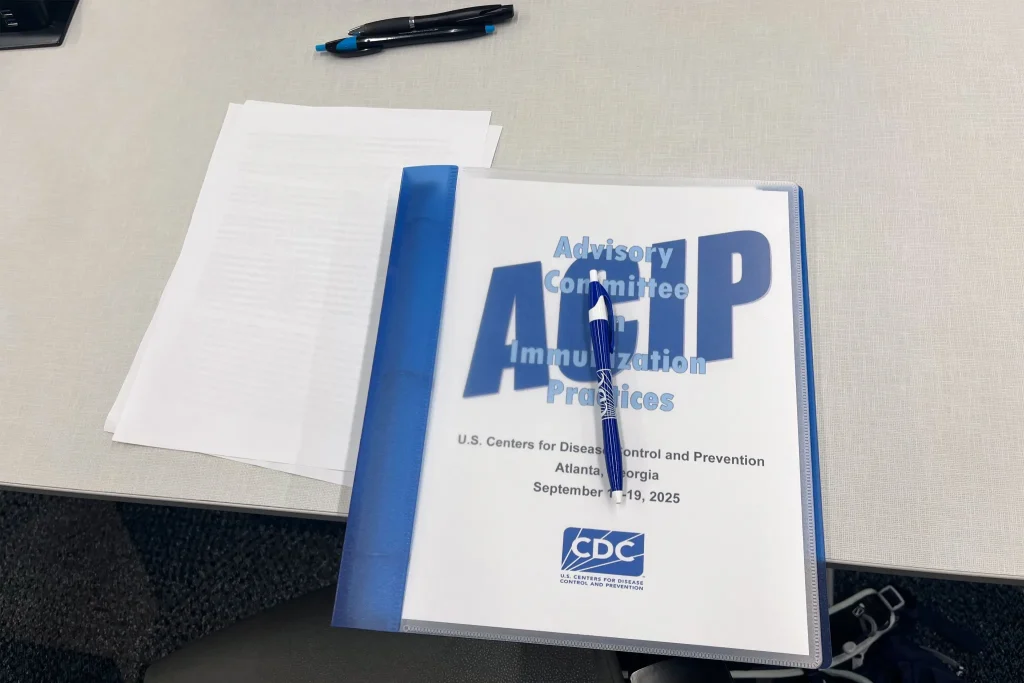
For decades, ACIP has been central to U.S. vaccination policy. Its recommendations influence state mandates, insurance coverage, and medical practice. Traditionally, the committee evaluated scientific evidence and epidemiological data to build consensus on preventing infectious disease. This time, the tone shifted. Many of the new members openly admitted limited expertise, asking questions settled long ago.
A Panel in Transition
Kennedy dismissed the prior 17 members in June and replaced them with 12 newcomers. Martin Kulldorff, the new chair, called the group “rookies” still learning complex science. Paul Offit of the Children’s Hospital of Philadelphia compared the meeting to a “mock United Nations,” except with real consequences for millions of families.
Critics warned the new panel gave vaccine skeptics a platform long reserved for health experts. On social media, opponents of vaccines have dominated debates. Now, in a CDC forum, their arguments faced direct scrutiny. That exposure often revealed weak evidence, though policy outcomes remained unclear.
Revisiting Settled Questions
Much of the two-day agenda revolved around long-answered issues. Why are two doses of the measles, mumps, and rubella (MMR) vaccine required? Pharmacist Hillary Blackburn posed the question, despite the fact that a second dose was added in 1989 after a deadly measles outbreak. The change achieved high immunity levels and nearly eliminated measles in the U.S., though recent outbreaks show ongoing risk.
MIT professor Retsef Levi misread hepatitis B data, suggesting infant cases had not dropped since 2005. In reality, the CDC recommended a birth dose in 1991, which proved key to reducing transmission. Levi questioned vaccinating “normal” households, echoing familiar skepticism of universal immunization.
CDC scientists Adam Langer and John Su countered with evidence that universal newborn vaccination suppressed hepatitis B over generations. Earlier strategies targeting only high-risk groups failed to control the disease. Broad coverage, they argued, was essential to protect the population.
Trust vs. Evidence
Some members pushed for placebo-controlled vaccine trials, considered unethical because they would deny children protection. Kulldorff and Levi emphasized “trust” rather than evidence. At one point, a member asked whether anyone would eat a hot dog containing thimerosal, a preservative long removed from most vaccines and never shown to cause harm.
Robert Malone, another skeptic, admitted the hepatitis B debate was about parental confidence more than science. “The signal that is prompting this is not one of safety; it’s one of trust,” he said. This highlighted the central challenge: distrust of institutions often outweighs data.
Historical Echoes
Vaccine resistance is not new. In the 19th century, critics described vaccinators as poisoning infants. Today’s skepticism draws on similar rhetoric, though global interconnectedness makes outbreaks far more dangerous.
Nurse Vicky Pebsworth of the National Vaccine Information Center cited selective studies to question safety. Levi referenced a 2004 Guinea-Bissau study suggesting higher infant mortality after hepatitis B vaccination. Experts dismissed it as irrelevant to the U.S., yet such claims reinforced calls for “more studies,” regardless of existing evidence.
Confusion and Decisions
The first day ended with an 8-3 vote recommending separate shots for MMR and chickenpox rather than the combined vaccine. A subsequent vote on aligning the Vaccines for Children program with this change caused confusion, requiring a revote.
The most consequential issue — whether to drop the hepatitis B birth dose recommendation — was pushed onto the agenda by Kennedy’s aides. Despite clear evidence of safety and benefit, debate continued. Ultimately, the committee postponed its vote, averting an immediate reversal of a successful public health policy.
Looking Forward
The meeting highlighted how political ideology can destabilize the immunization framework. Vaccine skeptics, once limited to fringe spaces, now sit inside the CDC’s advisory system. Public health experts warn this shift threatens decades of progress against preventable diseases.
While science largely prevailed during the debates, the long-term influence of skepticism within ACIP remains uncertain. The committee’s future choices will decide whether the U.S. continues to build on hard-won public health achievements or risks unraveling them under the weight of mistrust.
For families, physicians, and communities, the stakes are high: safeguarding children against diseases that earlier generations fought to control.